

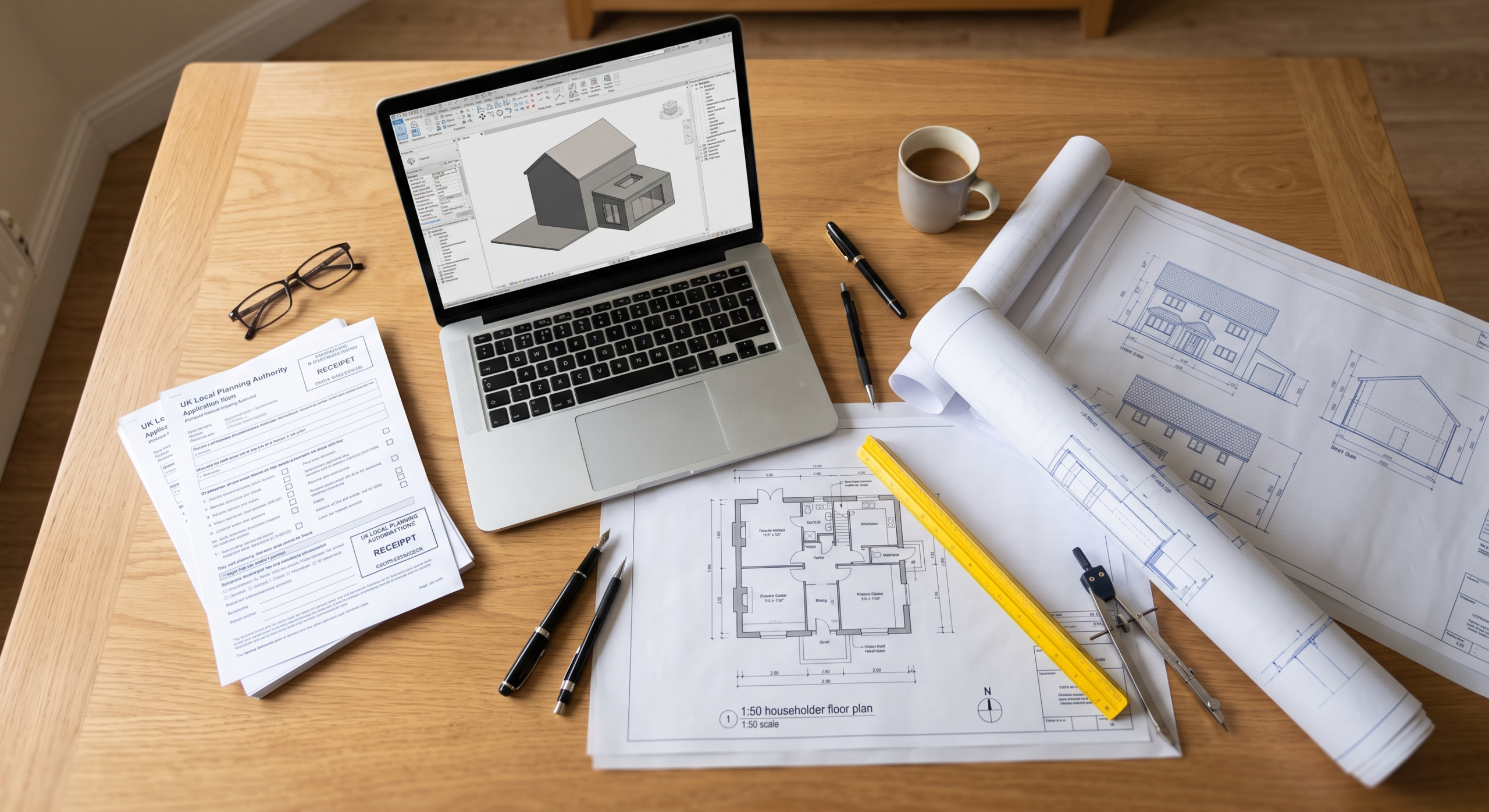
Planning Application Stages: A Complete UK Guide
Quick answer: A UK planning application typically moves through Six stages: pre-application advice, submission and validation, publicity and consultation, assessment, and decision. Most applications are determined within 8 weeks (13 for major schemes), though London boroughs often take longer due to higher consultation volumes and site complexity.
If you’ve never submitted a planning application before, the process can feel like a black box -you send off some drawings and forms, and weeks later a decision lands with little visibility into what happened in between. It isn’t actually that opaque. Every application, whether it’s a loft conversion in Ealing or a full commercial scheme, moves through the same core stages, just with different levels of scrutiny depending on scale.
This guide walks through each stage in order, what your local planning authority (LPA) is actually doing at each point, and where things typically go wrong.
What Is the Planning Application Process?
The planning permission application process is the sequence a local authority follows to assess a proposed development against national and local planning policy before deciding whether to grant permission. Whether you call it the planning permission process, the planning application process, or just “the planning process,” you’re talking about the same thing: submission, validation, consultation, assessment, and decision.
The legal framework sits under the Town and Country Planning Act, but you don’t need to read the legislation to get through it -you need to understand the practical sequence of events and what’s expected of you at each one.
One thing worth setting straight early: the process isn’t identical for every project. A householder extension, an outline application for a new development, and a listed building consent application all follow a similar shape but branch off at different points. This guide covers the standard path most homeowners and small developers will follow.
Before You Apply: Do You Need Planning Permission?
Before applying for planning permission, it’s worth checking whether you need it at all. A meaningful share of home improvement projects -certain extensions, loft conversions, and outbuildings -fall under permitted development rights, meaning you can build without a full application, subject to size and design limits.
If your project does need permission, there’s a useful (and often skipped) step before you submit anything: pre-application advice.
Pre-application advice isn’t mandatory, but for anything even slightly complex -a large extension, a site in a conservation area, a listed building, or a scheme likely to attract neighbour objections -it’s worth the fee. You get informal feedback from a planning officer before you commit to full drawings, which can save you a refusal (and a resubmission) down the line.
A few things that change your route into the process:
- Householder applications -small-scale alterations to a single dwelling (extensions, loft conversions, outbuildings)
- Full planning applications -new builds, larger schemes, changes of use
- Outline applications -establish the principle of development without full detail, followed by a separate “reserved matters” application
- Listed building consent -required alongside planning permission for any works affecting a listed building’s character
- Certificate of lawful development -used to confirm a project doesn’t need permission at all, useful if you want written proof rather than relying on your own judgment
If your property sits in a conservation area, factor in extra consultation requirements -these applications tend to move slower and attract more scrutiny by design.
The Planning Application Stages, Step by Step
This is the part most guides gloss over with vague timelines. Here’s what actually happens at each stage, and how long it realistically takes.
Stage 1 – Pre-Application Advice (Optional)
Covered above -this is the “check before you commit” stage. Councils typically charge a fee for this service, and turnaround is usually a few weeks. It’s not part of the formal application, so it doesn’t count against your statutory decision clock.
Stage 2 – Submission and Validation
You submit your application -forms, fee, drawings, and any required supporting documents (design and access statement, structural information, etc.) -usually via the Planning Portal or directly through your council’s own system.
The council then validates it. This isn’t a judgement on the merits of your project; it’s an administrative check that everything required is present. Missing a document or paying the wrong fee is one of the most common reasons applications get bounced back before they’ve even started being assessed.
Validation typically takes 1–2 weeks, though this varies by council workload
Stage 3 – Publicity and Consultation
Once validated, your application goes live on the council’s public register and enters a statutory 21-day consultation period. Neighbours are notified, site notices may be posted, and in some cases the application is advertised locally.
Depending on your site, statutory consultees might also weigh in -Natural England for sites near protected habitats, for example, or the local conservation officer for listed buildings and conservation areas. Anyone can submit comments during this window, supporting or objecting to the proposal.
Stage 4 – Assessment by the Case Officer
A case officer is assigned to your application and does the actual planning judgement work:
- Checks the proposal against the local development plan and relevant national policy
- Usually carries out a site visit
- Weighs up any objections or support received during consultation
- Considers “material planning considerations” -things genuinely relevant to planning, not personal preference (a neighbour disliking your choice of render colour isn’t a valid objection; loss of light to their windows might be)
- Requests further information if something’s missing or unclear
This is where most of the real back-and-forth happens. If the officer has concerns, they’ll often flag them and give you the chance to amend the scheme before a decision is made -better than an outright refusal, but it does add time.
Stage 5 – Decision
Most applications are decided by the case officer under delegated powers. Larger, more contentious, or high-profile schemes go to a planning committee instead, where elected councillors vote on the recommendation.
You’ll receive a formal decision notice: approved, approved with conditions, or refused. If conditions are attached, read them carefully -some need to be discharged (formally satisfied) before you can start work, which is its own mini-process.
Stage 6 – Appeal (If Refused)
If you’re refused, or unhappy with conditions attached to an approval, you have the right to appeal to the Planning Inspectorate. This is a separate process with its own timeline, and it’s worth getting professional input before deciding whether an appeal is the right move versus resubmitting an amended scheme -or in some cases, pursuing retrospective planning permission if work has already started.
Summary table:
| Stage | What Happens | Typical Duration | Who’s Involved |
| Pre-application advice | Informal feedback before you submit | A few weeks | Duty planning officer |
| Validation | Admin check -documents, fee, forms | 1–2 weeks | Council validation team |
| Consultation | Public and statutory consultee comment period | 21 days minimum | Neighbours, statutory consultees, parish/ward councillors |
| Assessment | Policy review, site visit, weighing objections | Runs alongside/after consultation | Case officer |
| Decision | Delegated sign-off or committee vote | Statutory: 8 weeks (13 for major) | Case officer or planning committee |
| Appeal (if needed) | Independent review of a refusal | Several months | Planning Inspectorate |
For a full breakdown of application types, see our guide to full planning permission.
How to Prepare and Submit Your Application
Getting your submission right the first time is the single biggest lever you have over how smoothly this goes. A properly prepared application is far less likely to get invalidated or delayed
What you’ll typically need to submit a planning application:
- Completed application form (via the Planning Portal or your council’s own portal)
- Site location plan and block plan, correctly scaled
- Existing and proposed drawings -elevations, floor plans, sections
- Design and access statement, if required for your application type
- The application fee, which varies by project type and scale
- Any additional reports –structural, ecological, heritage -depending on the site
Where to submit: most applications go through the Planning Portal, which routes them to the correct borough, though some councils run their own separate submission systems.
The most common reasons for a submission bouncing back at validation stage aren’t complicated -missing a drawing, submitting the wrong fee amount, or leaving a required box blank on the form. None of these are planning judgement issues; they’re just administrative gaps that cost you weeks if you get them wrong. If you’d rather not navigate this alone, it’s worth looking at planning consultants near me.
After Submission: Timelines, Costs, and What Can Go Wrong
The statutory clock says 8 weeks for most applications, 13 for major developments. In practice, especially across London boroughs, real timelines often run longer .
A few things commonly add time:
- Requests for further information -if the case officer needs more detail, the clock effectively pauses while you provide it
- Objections that trigger committee referral -a scheme that would normally be a quick delegated decision can end up waiting for the next committee meeting date
- Amendments mid-process -if you make significant changes to address officer concerns, consultation may need to restart in part
If your application is refused, you have two realistic paths: appeal to the Planning Inspectorate, or amend and resubmit. Resubmission is often faster and cheaper than an appeal, particularly if the refusal reasons are addressable through design changes rather than a fundamental policy objection.
Whether you need a planning consultant or architect isn’t a legal requirement -you can submit an application yourself. But a professionally prepared application, with drawings that anticipate the questions a case officer will ask, tends to move through consultation and assessment with fewer stumbles than a DIY submission that gets flagged for missing information partway through.
Timelines and process specifics can also vary by borough -see our dedicated guides for Wandsworth and Hackney.
What This Looks Like in Practice
We’ve worked on householder extensions where validation, consultation, and decision ran cleanly through the statutory 8-week window because the drawings and supporting documents were complete on first submission -no back-and-forth, no requests for further information, no surprises. That’s the outcome you’re aiming for: not a faster process on paper, but one with nothing to interrupt it.
We’ve also seen the opposite -an application that looked straightforward on paper but stalled at the consultation stage because a neighbour raised a legitimate loss-of-light concern that hadn’t been addressed in the original design. The fix wasn’t a resubmission from scratch; it was a targeted amendment to the roof profile that satisfied the objection without materially changing the scheme. That’s the kind of adjustment that’s far easier to make with someone who’s read the officer’s concerns correctly the first time, rather than guessing.
If you’re weighing up whether to handle a submission yourself or bring in professional support, the honest answer is: it depends on how much your project has going for it already -a straightforward single-storey rear extension on a standard plot is a different proposition to a loft conversion in a conservation area with a listed neighbour. You can browse examples of both types of projects we’ve taken through this exact process on our projects page, or get a quote if you’re ready to start.
Frequently Asked Questions
How many stages are there in a planning application? Most UK applications go through five to six stages: pre-application advice (optional), validation, consultation, assessment, decision, and appeal if needed.
How long does a planning application take from start to finish? The statutory limit is 8 weeks for most applications and 13 weeks for major developments, though real-world timelines -particularly in London -are often longer.
Do I need a planning consultant or architect to apply? It’s not legally required, but professionally prepared applications are generally less likely to be invalidated or delayed at submission.
What happens if my planning application is refused? You can appeal to the Planning Inspectorate, amend and resubmit your application, or in some cases apply for a certificate of lawful development if the issue is really about whether permission was needed at all.
Can my neighbours stop my planning application? Neighbours can object during the 21-day consultation period, but objections only carry weight if they raise valid planning grounds -loss of light or overlooking, for example -not personal preference about the design.
Sources
- GOV.UK –Determining a planning application
- Planning Portal –The decision-making process