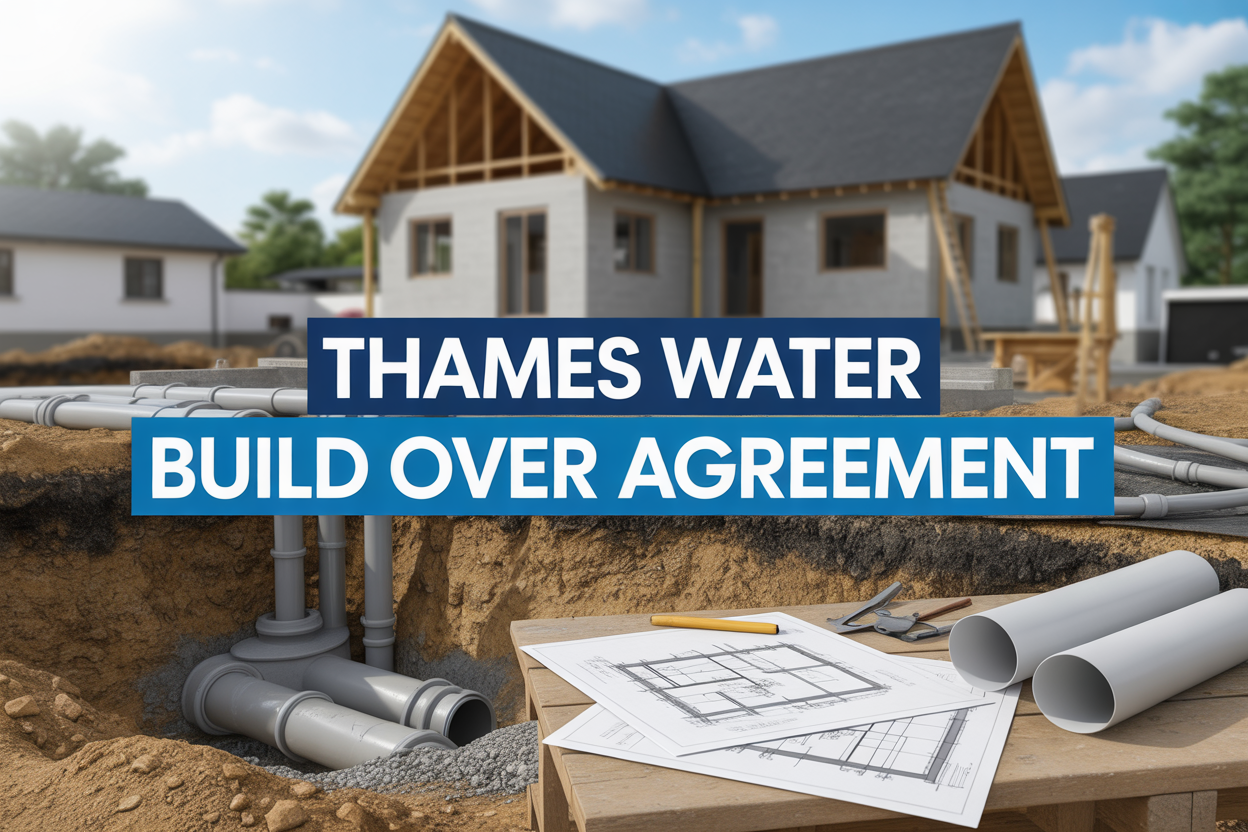
Securing a Thames Water build over agreement is a critical hurdle for any London-based extension or renovation project in 2026. If your proposed footprint sits within 3 metres of a public sewer or 1 metre of a lateral drain, the law is clear: you cannot break ground without formal consent.
At OAS, we specialize in navigating the technical overlap between architectural design and utility compliance. Building without this agreement isn’t just a risk—it’s a legal liability that can haunt your property’s value for decades.
When do I need a Thames Water build over agreement?
You must obtain a Thames Water build over agreement if your construction is within 3 metres of a public sewer or 1 metre of a public lateral drain. This applies to any structure—including extensions, conservatories, or walls—where the foundations could put pressure on, or restrict access to, the Thames Water sewage network.
1. Understanding the 3m/1m Rule
In the UK, most sewers located within your property boundary became “public” in 2011. This means even if a pipe only serves your house and one neighbor, it is likely a lateral drain owned by Thames Water.
- Public Sewer: A pipe serving multiple properties (requires 3m clearance).
- Lateral Drain: The section of the pipe serving your property that sits outside your boundary or is shared with a neighbor (requires 1m clearance).
Can you build over a sewer pipe?
Yes, but with strict conditions. You cannot simply pour concrete over a public sewer. You must implement a “bridge” or “lintel” system that transfers the building’s weight to the ground on either side of the pipe, ensuring the sewer itself carries zero load.
2. The Application: What You Need
A successful Thames water building over application requires more than just a form. You need technical evidence that the sewer will be protected during and after construction.
Technical Documentation Required:
- Site Location Plan: Showing the property in context.
- Existing and Proposed Floor Plans: Highlighting the sewer run.
- Cross-Sectional Drawings: Showing the foundation depth relative to the sewer pipe.
- CCTV Survey (Recommended): A Thames water build over agreement sample often includes a pre-construction CCTV report to prove the pipe isn’t already damaged.
Pro Tip: While many search for a Thames water build over agreement template, the actual “agreement” is a bespoke document generated by Thames Water after they approve your specific technical drawings.
3. Foundation Design: Bridging the Sewer
Standard trench foundations are rarely permitted when building over a sewer. Your structural engineer must design a solution that satisfies Build over agreement UK standards.
- Lintel Bridging: For shallow sewers, concrete lintels span the pipe trench.
- Pile and Beam: For deeper or larger sewers, vertical piles are driven on either side of the pipe to support a reinforced beam.
- Clearance: You must maintain at least 150mm vertical clearance between your foundation and the top of the sewer pipe.
4. Risks of Building Without an Agreement
Starting a buildover application retrospectively is a nightmare. If you build without consent, you face three critical risks:
Enforcement: Thames Water has the legal right to enter your property and excavate your extension to repair a sewer, and they are not legally required to put your house back together if no agreement was in place.
Property Sale Collapse: Solicitors will ask for the Thames water build over agreement pdf during the “conveyancing” phase. If you don’t have it, the buyer’s mortgage lender will likely reject the loan.
Indemnity Insurance Costs: While some people buy “indemnity insurance” to cover a missing agreement, this is often a “plaster on a broken leg”—it doesn’t solve the underlying risk of structural damage to the sewer
5.Timeline and Costs (2026 Projections)
- Application Fee: Usually ranges from £300 to £1,300 depending on the sewer size (Class 1, 2, or 3).
- Approval Timeline: Expect 3–5 weeks for the initial Thames water building over application assessment.
- CCTV Costs: Budget £250–£450 for the mandatory pre-and-post construction surveys.