

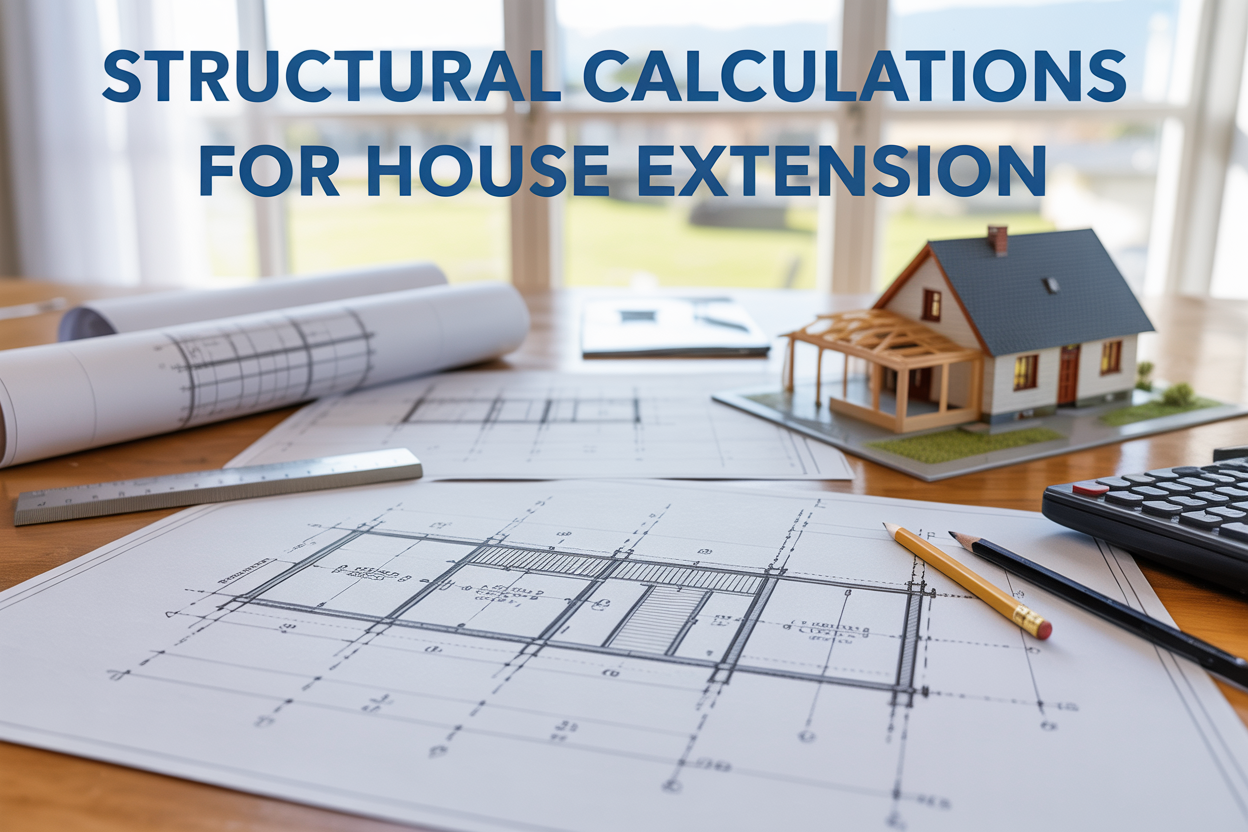
Planning a house extension in 2026 is an exciting way to add value to your property, but it isn’t just about the aesthetics of a new open-plan kitchen or an extra bedroom. Behind every successful build is a set of rigorous structural calculations for house extension projects. These calculations are the “math” that ensures your new walls don’t buckle and your roof doesn’t meet your floor unexpectedly.
At OAS, we bridge the gap between architectural vision and engineering reality. Whether you are navigating the tight building rows of Chelsea or expanding a semi-detached in the suburbs, understanding these technical fundamentals will save you from the “expensive surprises” that haunt unplanned projects.
( Structural Calculations for House Extension )
Why are Structural Calculations Mandatory?
In the eyes of the UK Building Control, structural calculations for house extension work are non-negotiable. They provide the evidence that your design is safe, stable, and compliant with current regulations.
- Safety First: Calculations determine the exact size and grade of steel beams (RSJs) needed to support the load.
- Building Control Approval: Without a stamped set of calculations, your local authority will not sign off on the work, which can stall your project or make the property impossible to sell later.
- Contractor Clarity: Detailed calculations allow your builder to quote accurately. If they have to guess the steel size, they will likely “over-engineer” it (costing you money) or “under-engineer” it (risking your safety).
The Value of a Structural Engineer Survey in London
If you are building in the capital, the complexity increases. A structural engineer survey London is often the first step in identifying site-specific challenges. London’s unique geology predominantly London Clay is notorious for shrinking and swelling based on moisture levels.
What the London Survey Uncovers:
- Soil Stability: Determining if you need standard strip foundations or more complex pile foundations.
- Party Wall Issues: Assessing how your extension will impact the structural integrity of your neighbor’s property.
- Existing Integrity: London has a high concentration of Victorian and Edwardian homes; a survey ensures the original structure can handle the new weight distribution.
Foundation and Material Specifications
Your structural engineer will analyze various forces to determine the materials required. These include Dead Loads (the weight of the building materials themselves) and Live Loads (the weight of furniture, people, and even snow on the roof).
Material Standards for 2026:
- Concrete: Typically specified at a compressive strength of $f_c’ \approx 20\text{–}30 \text{ MPa}$ ($3,000 \text{ psi}$) for foundations.
- Steel: Most extensions use Grade S275 or S355 structural steel. The required section modulus ($S$) is calculated using the formula:
$$S = \frac{M_{max}}{\sigma_{allowable}}$$
Where $M_{max}$ is the maximum bending moment and $\sigma$ is the allowable stress. - Reinforcement: No. 3 or No. 4 rebar is standard for enhancing the tensile strength of concrete footings.
( Structural Calculations for House Extension )
Professional Coordination: Architect vs. Engineer
A common pitfall is assuming one professional does it all. In reality, a successful extension is a relay race between your architect and your structural engineer.
| Role | Responsibility | Output |
| Architect | Aesthetics, layout, light, and planning permission. | Planning Drawings |
| Structural Engineer | Load-bearing analysis, steel sizing, and safety. | Structural Calculations |
| OAS Team | Coordinating both disciplines for a permit-ready set. | Full Building Regs Pack |
2026 Cost and Timeline Projections
Budgeting for an extension in today’s market requires a buffer for material volatility.
Estimated Costs (London & SE England)
| Item | Estimated Cost (2026) | Percentage of Budget |
| Architectural Fees | £2,500 – £5,000 | 5–10% |
| Structural Calculations | £800 – £2,000 | 2–5% |
| Construction (per m²) | £2,200 – £3,500 | 70–80% |
| Permits & Fees | £500 – £1,500 | 1–2% |
Typical Timeline
- Survey & Design: 4–6 weeks (Includes the structural engineer survey London).
- Planning & Calculations: 8–12 weeks (Local authority review).
- Construction: 12–20 weeks (Depending on complexity).
Success Strategies: Avoiding the Pitfalls
- Don’t Skimp on the Survey: A cheap survey often misses drainage issues or soil instability that can cost £10k+ to fix during construction.
- Light is Everything: When adding an extension, you risk turning the middle of your house into a cave. Use the engineering phase to calculate the largest possible openings for bi-fold doors or roof lanterns without compromising structural integrity.
- Neighbor Relations: Early communication prevents Party Wall disputes. If your structural calculations for house extension involve digging near a boundary, a formal Party Wall Agreement is a legal necessity.
How can OAS help you today?
We specialize in delivering permit-ready architectural and engineering sets that take the guesswork out of your build.
Would you like me to draft a checklist of the specific documents you’ll need for your local council’s building control submission?
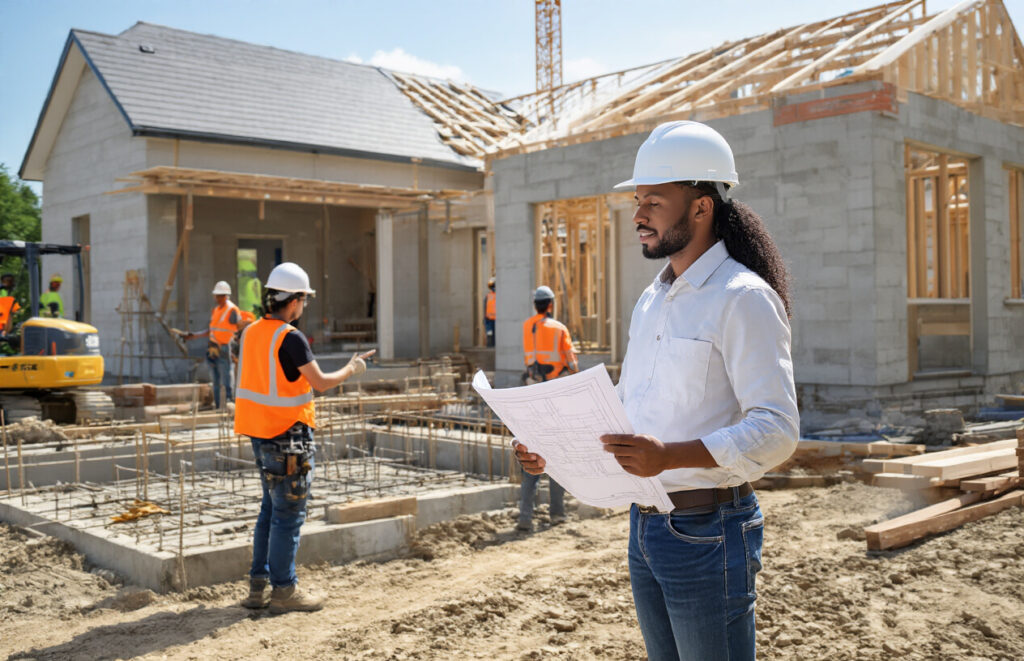
Structural Calculations for House Extension