

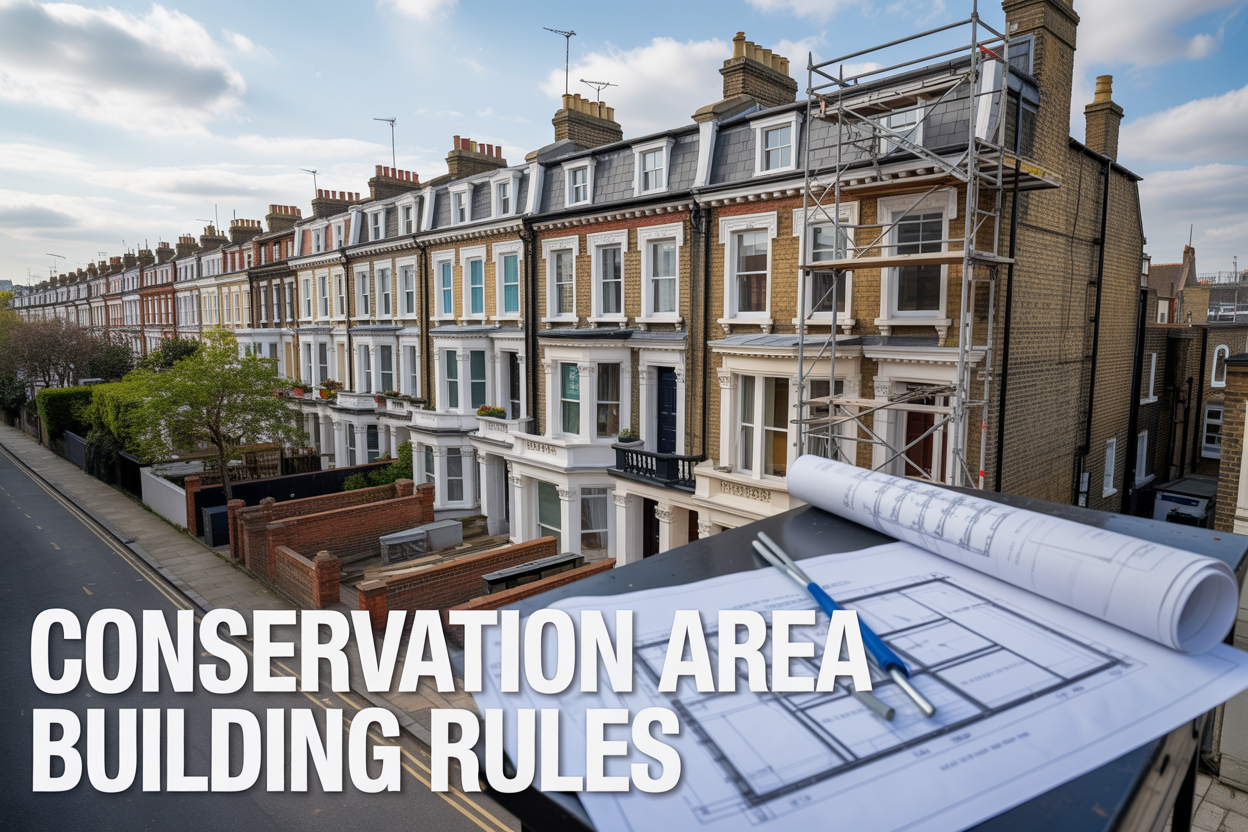
Building in a Conservation Area: The 2026 Strategy for Hackney, Islington, and Camden
Navigating the architectural “golden thread” of North London requires more than just a good builder; it requires a deep respect for the Planning (Listed Buildings and Conservation Areas) Act 1990. In boroughs like Hackney, Islington, and Camden, a “simple” window swap or a minor roof adjustment can quickly turn into a legal headache if you haven’t accounted for the local conservation area status.
As of 2026, these three boroughs remain some of the most strictly regulated in the UK, with hundreds of designated zones designed to preserve everything from Georgian terraces to industrial Victorian heritage. At OAS, we treat every conservation area project as a balance between 21st-century living and 19th-century soul.
Do I need planning permission for work in a conservation area?
Yes, most external building work in a conservation area requires full planning permission. Unlike standard residential zones, Permitted Development rights are often restricted by Article 4 Directions. This applies to window replacements, roof alterations, cladding, and even small extensions. Additionally, any work on trees requires a six-week prior notification to the local council.
1. Finding Your Zone: Maps and Postcodes
Before you pick up a sledgehammer, you must know exactly where your property sits on the conservation area map. Boundaries in London are granular; one side of a street might be protected while the other is not.
How to Conduct a Search
Using a conservation area search by postcode is the fastest way to verify your status. Most local authorities in London provide interactive GIS (Geographic Information System) maps. By performing a conservation area search by postcode London, you can see colored overlays indicating protected zones.
- Hackney: Look for the “Design and Conservation” layer on the Hackney Map.
- Islington: Uses a dedicated heritage layer that highlights all 42 of its protected zones.
- Camden: Provides a comprehensive “Find My Nearest” tool including conservation area boundaries.
- Regional Context: If you are looking further east, the Havering conservation areas map follows similar statutory guidelines but focuses on “garden suburbs” rather than dense Victorian terraces.
2. Borough Spotlight: Hackney, Islington, and Camden
Hackney: Protecting the Industrial and Residential Blend
In Hackney, the council uses conservation area planning permission to maintain the “visual amenity” of neighborhoods like Dalston and Victoria Park. Hackney is particularly strict about “Article 4 Directions,” which remove the right to change front boundaries or paint masonry that was historically unpainted.
Islington: The Retrofit Revolution
Islington covers approximately 50% of its land with conservation areas. In 2026, the borough is focused on “Retrofitting” historic homes. While they encourage double-glazing and insulation, they demand that these improvements don’t harm the “heritage asset.” Our Architectural Design Services focus on specifying thin-profile vacuum glazing that fits original timber frames.
Camden: Basements and View Corridors
Camden’s conservation area rules are famous for their complexity, especially in Hampstead and Highgate. Any basement extension in a Camden conservation area is a “major” development, requiring detailed soil and hydrological reports. Furthermore, Camden protects “view corridors” toward St. Paul’s Cathedral, meaning roof height is a non-negotiable factor.
3. Planning Permission Requirements & Restrictions
In a standard residential area in the UK, Permitted Development (PD) rights are a homeowner’s best friend. However, in a conservation area, those rights are often stripped away.
Roof Alterations and Dormers
Under standard conservation area london rules, roof enlargements (like rear dormers) are rarely allowed under PD. You must prove that the dormer is “subservient” to the original roofline. In 2026, many councils also require that new roof tiles match the “patina” and material of the neighboring houses exactly.
Windows, Doors, and External Cladding
The most frequent cause of planning enforcement is the unauthorized replacement of timber windows with uPVC. In a conservation area, the council will almost always demand timber sash windows. Using uPVC in these zones is considered a breach of planning, often requiring Retrospective Planning Permission which is frequently refused, leading to forced removal.
4. Tree Protection: The 6-Week Rule
Trees are treated as vital infrastructure in the conservation area map uk. If a tree has a trunk diameter of more than 75mm (measured 1.5m above ground), it is legally protected.
You must give the council six weeks’ notice in writing (a Section 211 Notice) before carrying out any work. This gives the arboricultural officer time to decide if the tree deserves a formal Tree Preservation Order (TPO). Failure to do this can result in unlimited fines—a mistake we see far too often in Havering conservation areas map zones and Central London alike.
5. The “10-Year Rule” and Enforcement in 2026
In April 2024, the UK government moved toward a unified 10-year rule for planning enforcement. If you perform unauthorized work in a conservation area today, the council has a full decade to discover it.
However, it is a critical mistake to think you can simply wait out the clock. If the work involves the total or substantial demolition of an unlisted building in a conservation area, this remains a criminal offense under the 1990 Act, and enforcement can be taken at any time—even decades later.
6. How to Build a Winning Application with OAS
To secure conservation area planning permission in 2026, your application must be “Heritage-Led.”
- Heritage Statement: This is a mandatory document. It shouldn’t just describe the work; it must assess the “significance” of the building and the “impact” of the change.
- Material Samples: We often suggest providing physical samples of bricks, slate, or lime mortar to the planning officer to show commitment to quality.
- Building Control: Never forget that planning is only half the battle. You will still need Building Regulations Support to ensure the new work meets modern fire and safety standards while respecting the old structure.
7. The SXO Strategy: Your Next Steps
Don’t gamble with London’s history. A failed application stays on your property’s permanent record and can hinder a future sale.
- Verify: Perform a conservation area search by postcode on your borough’s website.
- Consult: Speak with a specialist who understands the Islington Retrofit Handbook or the Hackney Design Code.
- Certify: Once work is done, ensure you get a Lawful Development Certificate to prove the legality of the work for future buyers.