

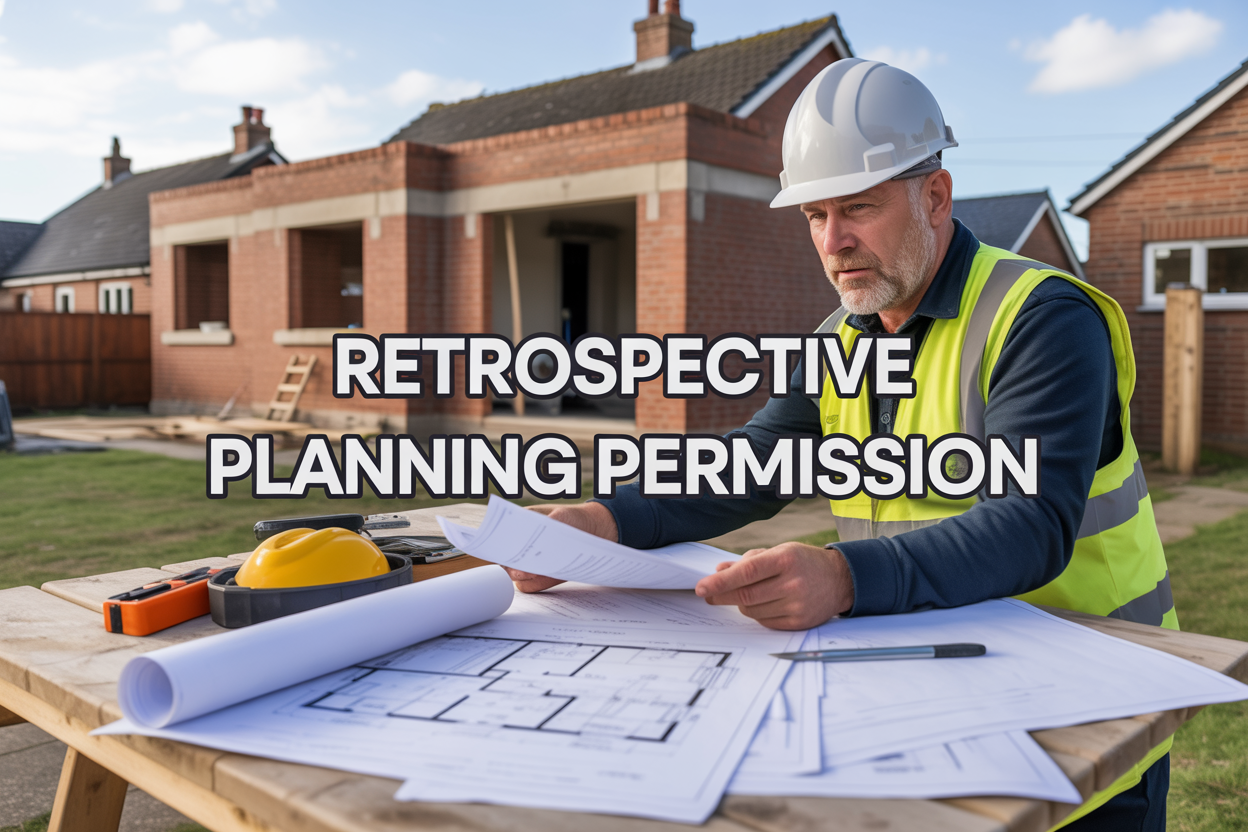
Realizing that your home improvement project lacks the necessary paperwork can be a high-stress moment for any property owner. Whether it’s an extension that exceeded its limits or an unapproved retrospective planning permission for a loft conversion, the threat of a council enforcement notice is a significant risk to your property’s value.
At OAS, we specialize in “regularization”—the professional process of securing retrospective planning permission to turn unauthorized developments into legally compliant assets. In 2026, this requires more than just a late application; it requires a strategic alignment with the latest gov uk enforcement policies and architectural standards.
“What is retrospective planning permission and how do I get it?
Retrospective planning permission is a formal application submitted to a local council for building work already completed without prior approval. To obtain it, you must submit “as-built” architectural drawings and a supporting statement proving the work complies with local planning policies. If approved, the development is legally regularized as if permission had been granted originally.
Understanding the 10-Year Rule for Retrospective Planning Permission
A major point of confusion for homeowners is the time limit for retrospective planning permission. Following the 2024/2025 legislative shifts in England, the traditional retrospective planning permission 4 year rule for extensions and lofts has been largely superseded by a unified 10-year rule for retrospective planning permission.
- The 10-Year Limit: The council now generally has 10 years from the date of “substantial completion” to issue an enforcement notice for most operational developments.
- Immunity vs. Permission: If your project was completed more than 10 years ago, it may be “immune” from enforcement. However, immunity is not the same as having permission. You will still need a Lawful Development Certificate to prove to future buyers or mortgage lenders that the work is legal.
Retrospective Planning Permission Cost Analysis
When budgeting for regularization, the retrospective planning permission cost must be viewed as a multi-layered investment.
- Council Fees: Usually identical to standard householder fees (approx. £258 in 2026).
- Architectural Documentation: You must provide high-precision “as-built” elevations and floor plans.
- Remedial Construction: If the council grants permission subject to changes (e.g., adding fire-rated materials), these physical costs must be factored in.
Common Retrospective Planning Permission Examples
To help you evaluate your situation, we have categorized the most frequent unauthorized works we regularize at OAS.
| Project Type | Common Breach | Key Compliance Factor |
| Loft Conversion | Volume exceeds 40m³ (terraced) or 50m³ (detached). | Must meet retrospective planning permission for a loft conversion design codes. |
| Rear Extension | Depth exceeds 6m/8m prior approval limits. | Impact on neighbor “Right to Light” and amenity. |
| Outbuildings | Height exceeds 2.5m near a boundary. | Overshadowing and “Overbearing” impact assessment. |
| Change of Use | Business activity in a residential zone. | Traffic generation and noise pollution reports. |
The “As-Built” Planning Audit
A successful application isn’t about apologizing; it’s about proving policy compliance. The council cannot refuse your application simply because you built it early. They must judge the work against the National Planning Policy Framework.
Why You Should Never Ignore a Council Letter
If the council discovers unauthorized work, they may issue a “Planning Contravention Notice” (PCN). This is a request for information. Ignoring this can lead to an Enforcement Notice, which is a legal instruction to demolish the work.
At OAS, we recommend a “Proactive Regularization” strategy:
- Talk to Neighbors: Most complaints come from neighbors. Resolving a boundary dispute privately can often stop a council investigation before it starts.
- Building Regulations: Remember that planning is only half the battle. You will also need a “Regularization Certificate” from Building Control to ensure the structure is safe, fire-protected, and energy-efficient.
Facing a planning issue? Get an OAS Retrospective Feasibility Review Today